
Abstract
Table of contents
Introduction
Most people want to eat more sustainable. Or in other words: Most people want to eat healthier. To improve their own health and that of the environment. But most of them do not act. That is a problem worth solving!
To quote Prof Dame Marteau: “People want to do the right thing, but life gets in the way.” So, how do we get it out of the way? One of the most difficult behaviours to change are the once turned into habits. Eating habits start building from the moment we are born and are deeply rooted in our being. Combine this with our everyday lives getting more and more full and stressful and you have an already tough habit to break with a little room to do so. This is a worthy challenge.
It is the goal of Leftover Lucy to help people eat more sustainable. Enabling people to break those habits is a key success factor. So, I did a dive in all that I could find to change habits effectively. I was happy to find out there is a lot available. Lots of information with the scope of educating the consumer and a lot of scientific papers and lots more. But I was missing something.
To make Leftover Lucy a success, it is important to consider the entire eating journey from start to finish and back as a system:
- What habits need to be changed,
- which change techniques are most effective,
- where in the journey,
- for the biggest positive impact?
A practical overview of this information is key to design and improve a system to help consumers break with their habits to start acting the way they want. All the papers, article, guides and soundbites provide a wealth of information but are focussed om a specific detail, and are, in the context over a practical system overview, fragmented. So I decided to create an overview. We need this overview as a guideline in our mission but could be helpful for other initiatives as well. And maybe we can improve the model together. That is why I am sharing it here. Feel free to share feedback, ideas and improvements.
Climate impact, quantified — for any recipe

Climate impact, quantified – greenhouse gas, land, and water in one honest number: the Leaf Cost. How many leaves will your dinner cost?
Why it is Important
The significance of the impact by our food system
That our food system is responsible for approximately 30% of the climate impact caused by humans is supported by research and accepted by most. But it is important to understand how significant that 30% is. Thankfully there is a lot of sound research in this area. One that stands out to me, is the EAT-Lancet commission. Not only because it is scientifically sound but excels in presentation, clarity and insight for normal but interested people like me. Their most powerful presentation of the impact of our food system is packed in a single image. It shows the impact of our food system relative to the planetary boundaries as defined by the Stockholm Resilience Centre (note: the total realised impact is from 2023 and increasing.):
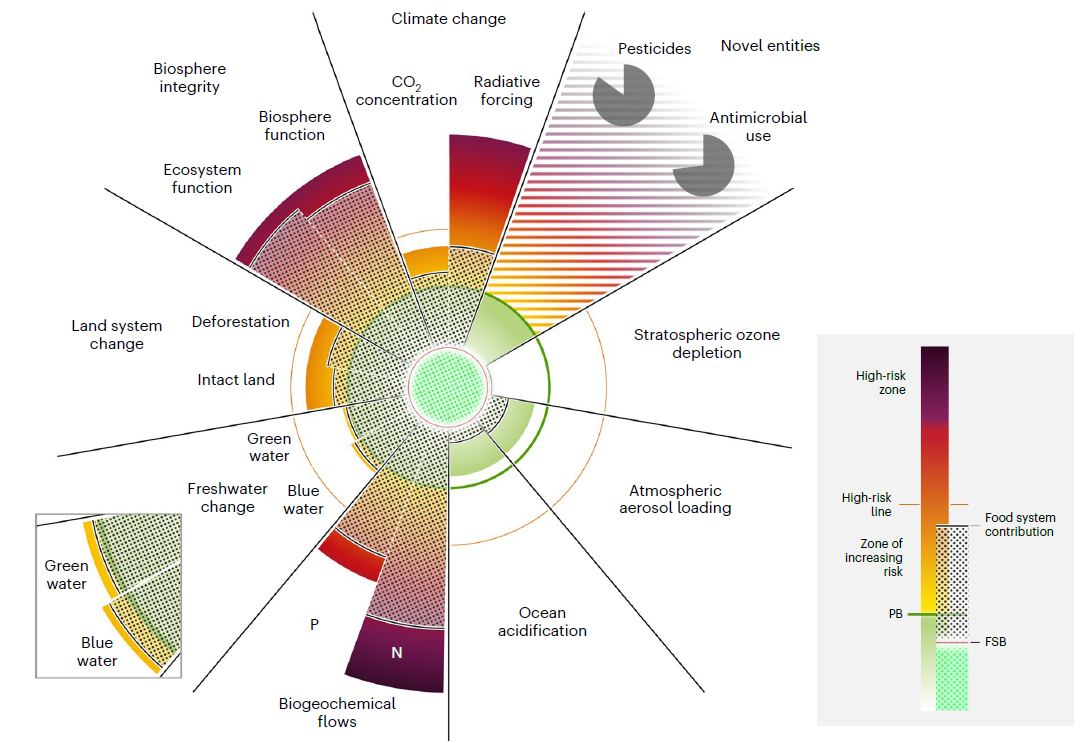
This is quite self-explanatory, but let’s zoom into a commonly referenced component, CO2 concentration:
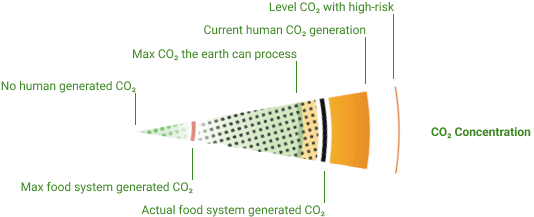
It clearly shows our current food system does not only generate more CO2 than what is regarded as acceptable for the food system, but it generates significantly more CO2 than the earth can reasonably process of all human related CO2 generating systems combined. Let that sink in: Our food system alone generates more CO2 than our earth can process!
Now zoom out and take all planetary boundaries in consideration. The climate impact share of our food system is ‘just’ around 30%, but the magnitude of it is overwhelming. The only conclusion that can be taken is that the significance of the climate impact by our food system is massive and deserves equal attention.
The relevance of focussing on consumer behaviour
General consensus is that the impact issue can only be addressed by changing the system as a whole. Not only due to complex interconnections but also because of the urgency and severity. All parts of the system need to be considered and addressed in order to be able to meet the required impact reduction. This argument alone is reason enough to give consumer behaviour focus alongside other approaches.
The driving force of consumer behaviour should not be underestimated as it reaches into other areas as well. In general there are 3 parties involved: the consumer (demand), the companies (supply) and the government (regulation and policies).
Yes, we, the consumer, need to do our part by changing our behaviour and do what is required. But that has a direct and significant impact on the other two parties. If we shift our purchasing power to sustainable food, the supply chain will adapt. We ‘vote’ with our purchases for the supply chain we will get. And that is the bridge to the government. A government represents the consumer and executes what we vote for. We determine the strategy and policies that our governments will follow. Obviously, these are two-way streets – consumers need the supply chain to enable them to make the right choice and our governments need to help us make conscious and educated choices – but it is the consumer that gets the fly-wheel spinning.
So, consumer behaviour is significant. Why does it need focus? Two reasons:
1. By far most effort, funding (public and private), policy making and regulation effort goes to improving the food supply chain. That is out of balance with the influence the consumer has on changing the system. Changing demand, changes the supply chain without making the system more complex with regulations and limitations.
2. While system thinking is becoming the go-to approach to address climate impact of the food system, enabling the consumer to make the right choice is fragmented at best. That is at most sub-optimal but it can even be counterproductive. When the first moment a consumer is provided with sustainable options, is in the supermarket, it will be to choose between an industrial steak or a biological steak. In that case the sustainable choice, is the more expensive choice. That is where the consumer perception is set: sustainable = expensive. This while a plant based protein source would have been more effective in terms of impact reduction but is also way cheaper. This is why we need to approach the consumer food journey as a system. Only then will we be able to truly help the consumer make the right decisions.
Who Should We Enable?
One of the key-takeaways of the 2025 EAT-Lancet commission was that the 30% richest people in the world is responsible for 70% of the food related climate impact.
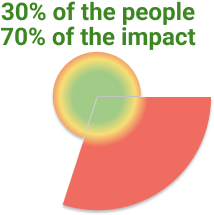
That is very useful information! Those are the people that:
- Are willing to change (over 2/3rd)
- Have the means to change (funds, access to education and sustainable food)
- Are the easiest to reach (they are all connected)
So, we know who to enable and we know the potential is there. We need to target the 30% richest people on the planet.
Consumer Decision Considerations
Percentages vary in the various researches but the most important food decision factors are taste, craving, price, and quality. Next is choosing healthy food and much farther down the line (on average around 10% of the people) actively factor in climate impact. That explains why, even though 67% is willing to change their eating habits, so few actually do.
This is very valuable information when trying to help consumers eat more sustainable. We need to make the sustainable choice meet the taste, craving, price and quality desires. And, again, this is not that difficult. How? Keep reading…
Behavioural Change Technique
Now we know why, who and what needs to change. To define the how we need to look at which options are available to change consumer eating habits for the better.
There are quite some scientific frameworks available to help and analyse behaviour change. COM-B and BCTT (v1) in combination with The Behaviour Change Wheel are omni present in research when addressing behaviour change to benefit climate and/or food consumption. If these frameworks are new to you, I do recommend reading up on those, but the goal of this article is to drill down to a practically usable guide. Instead of analysing the frameworks, we’ll dive straight into the methods that work or not, according to current findings.
Which Methods are available and How Effective are they?
Practically all papers indicated changing the decision structure as the most effective tool to change the consumer behaviour. This means that people are most likely to change their habits when they are presented with sustainable options as a default. E.g. low impact meals as the default in a restaurant menu, a food or recipe app, prominent position in the stores or simply highest availability.
This is a great rule of thumb to start with. But there are many discussions whether this method can be effective (enough) stand alone and how it will develop in the long run.
The paper “A meta-analysis assessing the effectiveness of demand-side interventions for sustainable food consumption and food waste reduction” by Paul M. Lohmann et al. (2026), provides an excellent summary of multiple papers covering the effectiveness of various ways to help consumers be more sustainable in their eating journey.
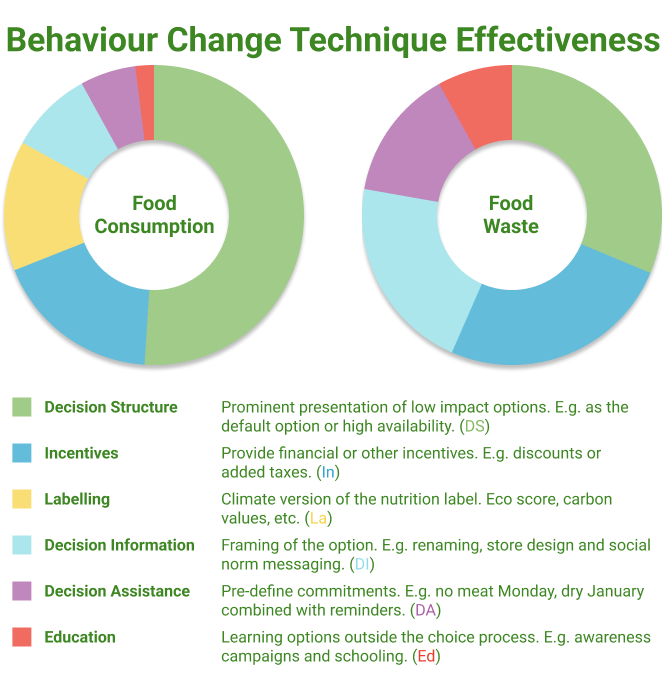
This research provides a great overview of the various behavioural change techniques, there potential and that they change depending on what behaviour is targeted.
Why be Cautious
It is always important to consider the nuances and variables in the researches and their results when deciding your implementation strategy.
All Techniques are Relevant
What should be noted here is that all techniques have shown relevant impact in the evaluated researches. Therefore, none should be ignored when developing a behavioural change strategy. Decision structure shows most promise but accounts for less than half of the total potential and seems less effective when targeting food waste behaviour.
What (Part of the) Eating Journey is Addressed?
Another consideration is what (part of the) eating journey is targeted. Most researches are conducted in a commercial environment. E.g. a company- or school cantinas or commercial restaurants. These provide a good impression of the effectiveness of a method, but when applying in another context (e.g. eating at home), different results could be expected. A research analysed different techniques in an food ordering app (similar to Uber Eats or Just Eat), which a) represents yet again a different eating journey, and b) the users were aware and incentivised to participate in the test. Which could influence the results. Especially researches evaluating behaviour change technique effectiveness on home cooking have been underrepresented. None evaluate the complete home cooking journey (meal planning, grocery shopping, storage, cooking and waste management), some evaluate waste management but most analyse consumer behaviour in supermarkets in complete isolation – discarding any influence from the rest of the journey.
Time is Relevant
Not all behavioural change techniques work at the same speed. Even effectiveness could change over time. Thake education for instance. Growing up in an environment where education about eating healthy for your body and the environment is omni-present, has a completely different effect than a single curriculum at a school where these topics are not popular. Timing and duration are critical to be considered as well.
Synergy is Key
Some tests were able to isolate a single change technique, but most evaluated a combination. This provided an interesting observation. Researches where decision structure was combined with another, seemed to show better results below the line. Together they seem to operate in synergy and make each other more efficient. It could be that the researches where multiple techniques were combined also applied the techniques more effective, but the amplification effect is consistent over the papers evaluated.
Education and labelling individually score relatively low. However, just looking at the Netherlands, there are thousands of different labels. Each relevant in their own field but overwhelming for the average consumer. Education oftentimes is theoretical and requires effort from the consumer to translate to actions in everyday life. Creating a bridge between the two could be an excellent example of how different techniques can amplify each other.
Implementation Quality
When evaluating a BCT, you are not only evaluating the technique, but also the quality of the application of the technique. This cannot be understated! The effect is a sum of the technique and the quality of the implication. The quality of the graphic design, UI and UX, placement, etc. They all play a role and they have to work together. To the point where they amplify each other.
Conclusion
Decision structure (default options and availability) is the most effective behavioural change technique and works well as a starting point but when the goal is to realise a significant effect, a system approach is required:
- The behaviour to be changed should be regarded within the system it resides,
- All behavioural change techniques must be considered and applied in synergy,
- and the quality of the implementation of the technique limits the effect.
It is ok to use these reported behavioural change technique effectiveness as a starting point, but each behavioural change system should incorporate a constant evaluation and optimisation loop.
Eating journey
Now we have an overview of behavioural change techniques and we know what the consumer values when making choices in their eating journey, it is time to define the eating journey to create a practical usable guide.
The eating journey is not a highly complex one but there are some important presentation considerations to make.
First of all, the eating journey is not a linear process, it is a loop. What remains after eating, is input for the following iteration. And variation in diet improves health and biodiversity. In a loop: Nothing gets wasted and we do not eat on repeat.
The second item is Storage. The stock in Storage is not really a step in the process but is directly relevant for each and every step in the journey. So that sits in the middle.
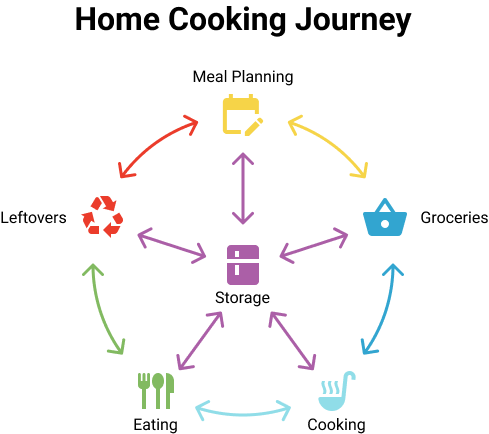
Now the steps in the journey are defined, let’s apply the behavioural change techniques to help consumers eat more sustainable.
Storage
As stated earlier, Storage is an odd duck – it is not a step in the journey but is relevant for each step that is.
Optimisation Benefits
The benefits from storage optimisation are obvious: Food- and money waste reduction. This does not need elaboration.
The Obstacles
Minimising and prioritising usages of stock in storage, is something the average consumer agrees with and acts on. The required ‘habit’ is already there but human memory is not perfect. We tend to forget things and when in doubt: We buy extra to secure our nourishment.
Way Forward
What is important is an easy to use and up-to-date inventory system that is available any time and everywhere. Critical is that this system is centralised per household and connected with and updatable by (any of) the system(s) supporting the steps in the eating journey.
Critical information:
- What is in stock
- How much is assigned to what (meal) and when
- How much is available with which remaining shelf life
Critical functionality:
- Near end-of-shelf-life identifiers and notifications
- Open connectivity
Note: The scope of Storage should be inventory. Stock utilisation and supplementing is distributed to multiple steps and possibly systems.
Visualisation

Meal Planning
Meal planning is maybe one of the most relevant steps to help consumers eat better. There is a reason it is at the top of the eating journey flow.
Optimisation Benefits
Meal Planning is where everything comes together. When done correctly, each eater will get the exact required nutrients, there is no waste, climate impact is limited and financial budgets are respected.
The Obstacles
The obstacles are numerous and significant. So much so that they can be divided into multiple categories.
Habits
Habits are easy, comforting, stress free. Your brain just goes on auto pilot. It doesn’t judge – it just execute. As an example: When you have a set meal plan for the week, that creates space in your head. You do not have to be creative over and over again. But there are a lot of downsides that come with it.
From a nutrition perspective, your diet is way to homogeneous. Your health will suffer from the lack of diversity in certain macro- and micro nutrients.
From climate perspective, a fixed meal plan usually has its roots in old habits which have proven to be damaging. But even when the fixed meal plan is carefully chosen, the repetition makes it impossible to sustain biodiversity.
And from the eating experience perspective, there is no stimulation, no surprise. Eating is not only a necessity but also an experience. It is alone time, or time with family and friends. It is a good conversation, culture, history and so much more than that. All these things are incredibly valuable to the health of your body and mind. When the food does not provide stimulation due to its repetitiveness, people will search for quick dopamine fixes in food or snacks with high levels of sugar, fats and salt.
So, habits are understandably difficult to break, but very worthwhile when deciding what to eat.
Knowledge
Most of us know what to eat…as long as we keep composing our plates as we were used to. And that is exactly where the problem lies. We need to change the composition of our plates while meeting nutritional goals. Suddenly there is a need to tap into knowledge we rarely needed to access. And it requires knowledge in three different fields. 1) We need to know which foods have a high impact and which not. 2) We need to do this while maintaining our nutritional goals. And 3) we need to know recipes for those new (main) ingredients that are appealing and can satisfy us. There is a reason there are professions such as dietician and nutritionist.
Time
Planning new meals and acquiring the relevant knowledge cost time and effort. And that time is something many people are not able or willing to create.
Household dynamics
Most households are not stable. Some overtime is required at work, one of the kids eats over at friends, you schedule an extra session at the gym, to name but a few. And they all impact meal planning. So, we tend to create safety buffers which, in many cases, lead to food waste.
Way Forward
There is a lot to overcome but with a little help, everything becomes easy. And yes, easy is the keyword to success!
THE way to help consumers overcome the obstacles, is to do it for them. Simply autogenerate the meal plan. But there are a couple of critical success factors.
Control
Nobody likes to lose control. Freedom and control of our own lives is precious. The sense of limitation will kill the possibility for success in an instant. Any solution should provide the user to control the variables driving the selection system and easy meal planning alteration options. Flexibility, UI and UX are key!
Taste
Finding the taste, or rather eating experience, of the user(s) is another key success factor. In the end the most important food decision factors are taste, craving, price, and quality. To be able to generate meal plannings, the expectations of the user(s) on these factors need to be known and met. Learn them, and user them!
Nutrition & Impact
Compose the meals by combining and portioning recipes to meet the daily nutrition- and impact goals of the user(s). Not everybody is at the same protein transition level and only when the personal levels are respected, this can work at scale. Guide the user(s) with reference levels and defaults, but let every user make their own choice.
When a user makes manual changes to the meal planning, a) adjust portions to meet nutritional goals, and b) provide feedback on both nutritional and climate impact consequences. Good and bad. Working with meal planning like this will give a ‘learning by doing’ experience without the sense of limitation.
Last but not least, focus nutrition target evaluation on daily bases but climate impact mainly on weekly bases. That will motivate them on most days to create guilt-free space for ‘guilty pleasures’ on special occasions. It creates the sense of freedom that is earned.
Dynamic
A meal plan should always remain dynamic. Leftovers are added to the stock. Additional eaters come unexpectedly. Cravings change. A meal planning needs to be able to process these changes. On the spot. If not, it can even work counterproductive, but will certainly lose effectiveness, usability and users.
Trimmings and Other Cooking Waste
When compiling a plan, the system is also aware of the trimmings and other cooking waste to be expected. Providing suggestions what to do with that is simple to add to the solution. Suggest recipes (potato skin crisps, process to spices and other flavour makers), ways to keep and add back to the storage as input for rolling planning.
Visualisation

Groceries
The impact of doing groceries on the climate is seriously underestimated. This is one of the steps where most household food waste can be addressed. On this topic I found one paper that was particularly insightful, written by M. A. van Rooijen et al. at Wageningen University: “Meal planning under uncertainty: How shopping frequency affects food waste”. Let’s dive into practical guidance options for the consumer.
Optimisation Benefits
This is where buying exactly what is needed when it is needed can occur and approximately half of current household food waste can be prevented. And this step defines the type and origin of the groceries. This is where the choice for industrial or biological or regenerative occurs. Whether local or global produce is chosen. Short supply chains or big industry. These are all very relevant optimisation potentials.
The Obstacles
First of all, going to the shop without an actual list is one of the major issues. That is when people tent to overbuy and fall for promotion traps.
Second, changing plans account for a large portion of food wasted. Plans change, leftovers become available, and so on.
Third obstacle is time and possibility of the consumer to go do the groceries. Not every person can go every day or has access to multiple types of shops.
And, number four, choosing the right store- and product option is challenging. Choosing between biological and industrial produce can be difficult and labelling confusing. How much is the impact difference and is that relevant? Does it warrant possible price differences from the user’s perspective? Are the standardised portions in the supermarket matching with what is needed? What are the benefits when buying from the local specialised stores such as the local greengrocer? How do I organise the groceries over multiple shops?
Way Forward
Making doing the groceries right more easy, takes a couple of considerations but is certainly doable.
Consolidation
Any grocery management solution stands and falls with the ability to centralise all grocery shopping functionality. Consolidation is the keyword.
A good grocery solution consolidates input from systems such as meal planners and inventory systems. For this, open connectivity is again key, even when working with an integrated solution.
Planning
A way to limit waste is obtaining groceries only when they are needed at the moment they are needed. However, nobody has the possibility to run to 4 different shops. 3 times a day. What is needed here, is a solution where the user indicates what their available shopping moments and frequencies are, and the system determines the optimal shopping schedule. Initial, the system will require input from the user on the stability of the household, but going forward the planning should be optimised by gathering actual dynamics.
Divide and Conquer
To minimise climate impact, shopping scheduling needs to take into consideration multiple factors, amongst others the required portion availability. Supermarkets have standardised portions, while local specialised shops often offer custom portions. An other factor is the availability of local produce. Again local specialised shops tend to perform better. And the same goes for biological or regenerative produce and short supply chains. So key is the system should automatically suggest optimised shopping list splits. And to make trips to multiple shops more manageable, it should be possible to optimise for multiple people in a household to do (certain) shopping.
Visualisation

Cooking
Even though this is not the most impacting step, some optimisation can be achieved here. Where this step can make the difference is making life of the user much easier. Surprisingly because most apps and cooking platforms claim to focus and excel on this step.
Optimisation Benefits
Easier cooking removes thresholds to trying new recipes. Better recipes. Better for health, climate and taste. That reason is already enough to allocate effort to this step, but as a part of an integrated system with support for other steps as well, this optimisation might be the reason users will start using the solution and reap the benefit of the other optimisations as ‘collateral damage’.
The Obstacles
Obviously, step-by-step guidance for a recipe is critical with an outstanding UI/UX is important. But where most advancement can be achieved is the actual cooking planning.
The cooking guidance should combine the steps of multiple recipes into a single step-plan for an entire meal with multiple courses. The steps that can be executed ahead of time, should be offered as a possibility. Even covering multiple days. A user should be able to plan eating times and cooking time availability, so the cooking guidance can plan accordingly, notify possible conflicts and offer alternatives. And with this guidance, all default calendar functionality such as alarms and notifications should be available.
A great optimisation functionality would be if the solution could evaluate recipe duration estimates with the users’ actual cooking times, to improve the planning for the future.
Visualisation

Eating
This is the part where the users should enjoy themselves with their eating companions.
Optimisation Benefits
In this step not a lot can be optimised. What is possible, is gathering information to a) improve recipes, and b) get a better understanding of the preferences of the user to improve future suggestions and guidance.
The Obstacles
he user is ready after eating and moves on to other things.
Way Forward
Prompt the user actively for low effort feedback with an easy option to drill down and elaborate.
Visualisation

Leftovers
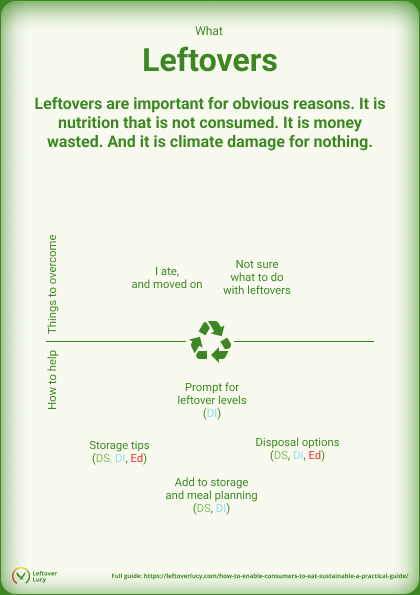
Leftovers are important for obvious reasons. It is nutrition that is not consumed. It is money that is wasted. And it is climate damage for nothing.
Optimisation Benefits
By preventing leftovers from going to landfill, that nutrition, money already spent and climate impact already done is not wasted and the necessity of others prevented.
The Obstacles
People struggle what to do with leftovers. How to store, how to use as food later on, and what utilisation alternatives there are instead of throwing into the trash. Not everybody can be a specialist. And – just like getting feedback on the meal – people move on to other things after the meal.
Way Forward
The best way to help consumers is to prompt them with options for the leftovers. The system knows exactly what was in the meal and what options are available. Simple and easy guidance makes all the difference here.
Visualisation
Additional Possibilities
So far, we have focussed on practical support of the eating journey steps. But there are other possibilities at a higher level. Fitbit and Duolingo are masters in the field of habit formation and user engagement through gamification. The methods applied there can easily be applied to nutrition and climate impact. They both provide metrics for which goals can be set, can be tracked and gamified. Habit formation through ‘streaks’ in days within calories or CO2 load. Create competitions and comparisons with communities, family and friends. All perfectly useful to help change the eating habits of the consumer that is willing but not changing yet.
Inspiration
People to Follow
These are some people that share incredible insights for the search of helping people eat more sustainable:
Sophie Attwood PhD – Behavior Global (Scientific papers)
Paul Lohman – El-Erian Institute of Behavioural Economics and Policy @ Cambridge (Scientific papers)
Frank Holleman – Fork Ranger (Storyteller with practical consumer guidance to eat more sustainable)
Organisations to Follow
These are obvious but need to be mentioned:
Wageningen University & Research – https://www.wur.nl/en/library
Eat Forum – https://eatforum.org/
Eat-Lancet – https://eatforum.org/eat-lancet
Papers Consulted
Evaluating dynamic norm messages and alternative interventions to reduce meat consumption in cafeterias
2026, Biggs, Elizabeth; Naz Çoker, Elif; Garnett, Emma; Milner-Gulland, E.J., https://doi.org/10.23668/psycharchives.21550
A meta-analysis assessing the effectiveness of demand-side interventions for sustainable food consumption and food waste reduction
2026, Lohmann, P.M., Pizzo, A., Bauer, J.M. et al., https://doi.org/10.1038/s43016-025-01279-9
Identifying behaviour change techniques for sustainable food consumption: A systematic review using the BCTTv1
2025, Anna S.C. Tirion, Danielle D’Lima, Julia Terlet, Ramya Rao, Leslie M. Gutman, https://doi.org/10.1016/j.appet.2025.108057
Appendix to “A Restatement of the Protein Transition”
2025, O Duluins, R Cardinaals, H Potter Karlsson, S Nájera Espinosa, K Resare Sahlin, J J L Candel, S Hornborg, A Matthews and P V Baret, https://doi.org/10.1088/1748-9326/ade86f
Karakteristieken en motieven waarom burgers lokaal voedsel kopen
2025, Hassink, J., Stuck, L., Greil, S., Polderman, E., in ‘t Veld, W., van Dam, A., Walma, K., & Schoop, D, Wageningen University & Research. https://doi.org/10.18174/700574
Meal planning under uncertainty: How shopping frequency affects food waste
2025, M.A. van Rooijen, J.C. Gerdessen, G.D.H. Claassen, S.L.J.M. de Leeuw, https://doi.org/10.1016/j.spc.2025.05.015
Matching Interventions to Mental Processing: Testing the Targeted Interception Theory of Behaviour Change
2025, Danyelle Greene, Anna Kristina Zinn, Sara Dolnicar, https://doi.org/10.31235/osf.io/2ap3b_v1
The EAT–Lancet Commission on healthy, sustainable, and just food systems
2025, Rockström, Johan et al., Link
Choice architecture promotes sustainable choices in online food-delivery apps
2024, Lohmann, Paul M, Gsottbauer, Elisabeth, Farrington, James, Human, Steve, Reisch, Lucia A, https://doi.org/10.1093/pnasnexus/pgae422
In our hands: behaviour change for climate and environmental goals
2022, Parliament UK, Link
A reversal of defaults: Implementing a menu-based default nudge to promote out-of-home consumer adoption of plant-based meat alternatives
2022, Danny Taufik, Emily P. Bouwman, Machiel J. Reinders, Hans Dagevos, https://doi.org/10.1016/j.appet.2022.106049
Minderen vleesconsumptie: gedrag & motivaties
2021, Lieke Bos, MSc. Cecilia Keuchenius, MSc, Link
Healthy Diets From Sustainable Food Systems – Food Planet Health
2019, EAT-Lancet, https://eatforum.org/wp-content/uploads/2025/09/EAT-Lancet_Commission_Summary_Report.pdf
A Systematic Review of Digital Behaviour Change Interventions for More Sustainable Food Consumption
2019, Hedin, B.; Katzeff, C.; Eriksson, E.; Pargman, https://doi.org/10.3390/su11092638
Book Tips
Books from some of the greatest food system thinkers: https://leftoverlucy.com/sustainability-and-food-a-reading-list/
Personal Note
This is my personal vision on how to help consumers eat more sustainable. The only way forward is to keep learning. That is why I needed to share this article and why I would love to get your feedback.
Let’s Work Together
I firmly believe cooperation is key to success in any endeavour. And we have reached a point where the only way create a future with a sustainable food system, is by working together. So, let’s work together!
Do not hesitate to get in touch for a consult, exchange ideas, start a project together, on changing the behaviour of the consumers or any other topic related to climate impact by our food system.



Leave a Reply